




Creatine is one of the most researched supplements in sports nutrition. Yet somehow, taking it has become incredibly complicated.
Do you need to load it? Take it before training? Mix it with sugar? Add salt? Use warm water? Drink extra water? And what form of creatine should you be using?
Behind some of these claims is a little bit of science. Behind others is mostly marketing.
So instead of making creatine more complicated than it needs to be, let’s look at what the research actually says.
First: What Does Creatine Actually Do?
Your body naturally produces creatine, and you also get small amounts from foods such as meat and fish.
Most of the creatine in your body is stored in your muscles, where it helps replenish ATP - the energy your cells use during short, intense efforts like lifting, sprinting and jumping.
Supplementing with creatine increases the amount stored in your muscles. Over time, this can improve high-intensity exercise performance and help support greater gains from resistance training. Creatine is also increasingly being researched outside of sport, including for brain function and healthy ageing.
But the key word here is stored.
Creatine isn't like caffeine, where you take a dose and feel an acute effect shortly afterwards. Its main benefits come from gradually increasing and maintaining your body's creatine stores.
And that explains a lot of the answers below.
1. Do You Need a Creatine Loading Phase?
No.
A traditional loading phase usually involves taking around 20–25 g of creatine per day for 5–7 days, split across several smaller doses. After that, you switch to a maintenance dose of around 3–5 g per day.
Loading works. It simply fills your muscle creatine stores faster.
But you can reach essentially the same destination by taking a smaller dose every day.
In a classic study, taking 3 g per day for 28 days produced a similar increase in muscle creatine to taking 20 g per day for six days.[1]
So why load?
If you want to maximise your creatine stores as quickly as possible - perhaps before a competition or training block - loading can make sense.
For everyone else, it's perfectly fine to skip it.
2. How Much Creatine Should You Take?
For most people, 3–5 g of creatine monohydrate per day is a well-established and practical dose.
Research reviews also sometimes use approximately 0.1 g per kilogram of body weight per day, particularly in larger individuals.[2]
But unless you have a specific reason to calculate it by body weight, there is little need to overcomplicate things.
A consistent daily dose matters more than obsessing over the perfect gram.
3. When Is the Best Time to Take Creatine?
You may have heard that creatine needs to be taken immediately before or after your workout.
The evidence isn't strong enough to say that.
Some studies have suggested that taking creatine close to training - particularly after exercise - could potentially have a small advantage. Exercise increases muscle blood flow, so the theory makes sense.
But reviews of the available research conclude that we still don't have enough evidence to establish an optimal pre- versus post-workout timing strategy.[3]
And because creatine works primarily by maintaining elevated muscle stores, the bigger priority is much simpler:
Take it consistently.
Morning, evening, before training or after training can all work.
Choose the time you're least likely to forget it.
4. Should You Take Creatine on Rest Days?
Yes.
Your muscles don't suddenly empty their creatine stores because you didn't train that day.
Once you've increased your muscle creatine stores, daily supplementation helps maintain them. That's why creatine makes sense on both training and rest days.
Think of it less like a pre-workout and more like something you build up over time.
Skipping one day isn't going to ruin anything, but there is also no reason to intentionally cycle creatine around your training schedule.

5. Should You Take Creatine With Sugar?
This one is interesting because there is actually some truth behind the idea.
Research has shown that consuming creatine alongside a large amount of carbohydrate can increase muscle creatine retention.
In one study, participants consumed 5 g of creatine followed by 93 g of simple carbohydrates. Muscle creatine accumulation was significantly greater compared with creatine alone.[4]
Other research found that combining protein and carbohydrates with creatine can produce a similar effect, likely because the resulting insulin response helps increase creatine retention.[5]
So should you start mixing 100 g of sugar into your creatine?
Probably not.
The studies demonstrate an interesting physiological effect, but you're weighing that against consuming hundreds of additional calories simply to optimise something that already works extremely well on its own.
If you're already eating a meal containing carbohydrates and protein, taking your creatine around that meal is perfectly reasonable.
But you don't need sugar for creatine to work.
6. Does Adding Salt Help Creatine Absorption?
This one sounds surprisingly convincing once you understand the mechanism.
Creatine enters muscle cells through a sodium-dependent creatine transporter, and laboratory research has shown that reducing sodium concentrations can substantially reduce creatine uptake.[6]
The fact that the transporter requires sodium does not mean that adding extra salt to your creatine has been shown to increase muscle creatine stores or improve your results in humans.
Your body already maintains tightly controlled sodium concentrations, and we currently don't have convincing human evidence showing that deliberately adding salt to a normal creatine dose produces better outcomes.
If you like taking your creatine with an electrolyte drink or alongside a meal containing sodium, that's completely fine.
7. Should You Mix Creatine With Warm Water?
Warm water can certainly make creatine monohydrate easier to dissolve.
And this is probably where some of the claims around warm water originated.
One study found differences in plasma creatine concentrations when creatine was consumed fully dissolved compared with a crystalline suspension in ice-cold water.[7]
But there's an important distinction:
Better solubility does not necessarily mean greater muscle uptake or better results.
A major review of the creatine literature specifically notes that although increasing temperature improves the solubility of creatine monohydrate, solubility itself has not been shown to determine tissue uptake.[2]
So if your creatine dissolves more easily in room-temperature or warm water, go for it.
If you prefer an ice-cold drink?
That's also completely fine.
You haven't suddenly made your creatine ineffective.
8. How Much Water Do You Need With Creatine?
There is no scientifically established magic amount of water you need to drink with each gram of creatine.
You may see very precise claims online suggesting that 5 g of creatine monohydrate requires hundreds of millilitres of water for proper absorption.
That's a good example of turning solubility into an absorption claim.
Creatine monohydrate is already highly bioavailable, and research does not support the idea that you need to drink an enormous amount of water with every dose for it to work.
You should still stay properly hydrated.
But that's good advice whether you take creatine or not.
9. Does Creatine Make You Bloated?
Creatine can increase water in the body, particularly during the first few days of a high-dose loading phase.
That's real.
But it often gets described incorrectly.
Creatine is stored primarily inside muscle, and increases in creatine can be accompanied by increases in intracellular water - water inside the muscle cell.
That's very different from the idea that creatine automatically leaves you looking soft, swollen or bloated because water is sitting underneath your skin.
Research on longer-term supplementation is mixed regarding changes in total body water, but the evidence does not support the idea that creatine inevitably causes chronic extracellular water retention.[2]
If you're particularly concerned about a sudden increase in scale weight or water during the first week, there is an easy solution:
Skip the loading phase and simply take 3–5 g per day.
Your creatine stores will increase more gradually.
10. What form of Creatine should you take?
This is probably where creatine marketing gets most confusing.
There are now numerous forms available, including creatine HCL, citrate, pyruvate, nitrate and others.
Some of these forms are more soluble in water than creatine monohydrate.
But again:
More soluble does not automatically mean more effective.
What actually matters is whether a form produces better muscle creatine accumulation, performance, strength or other meaningful outcomes.
And so far, the evidence has not demonstrated that these alternative forms consistently outperform creatine monohydrate.
A 2022 systematic review examining alternative forms concluded that creatine monohydrate remains the most extensively studied form, with the strongest evidence for efficacy, safety and cost-effectiveness.[8]
A separate critical review reached a similar conclusion: creatine monohydrate remains the only form with substantial evidence supporting its bioavailability, efficacy and safety.[9]
So What's the Best Way to Take Creatine?
After all of that, the answer is refreshingly boring.
Take 3–5 g of creatine monohydrate every day.
You don't need a loading phase. You don't need a sugar drink. You don't need a specific amount of salt. You don't need to take it exactly 30 minutes before training. And you don't need to worry if your water isn't warm enough.
There are small details that may influence creatine retention or how easily it dissolves.
Creatine is already one of the simplest and most effective supplements available.
There is no need to make it complicated.
Why We Use Creatine Monohydrate
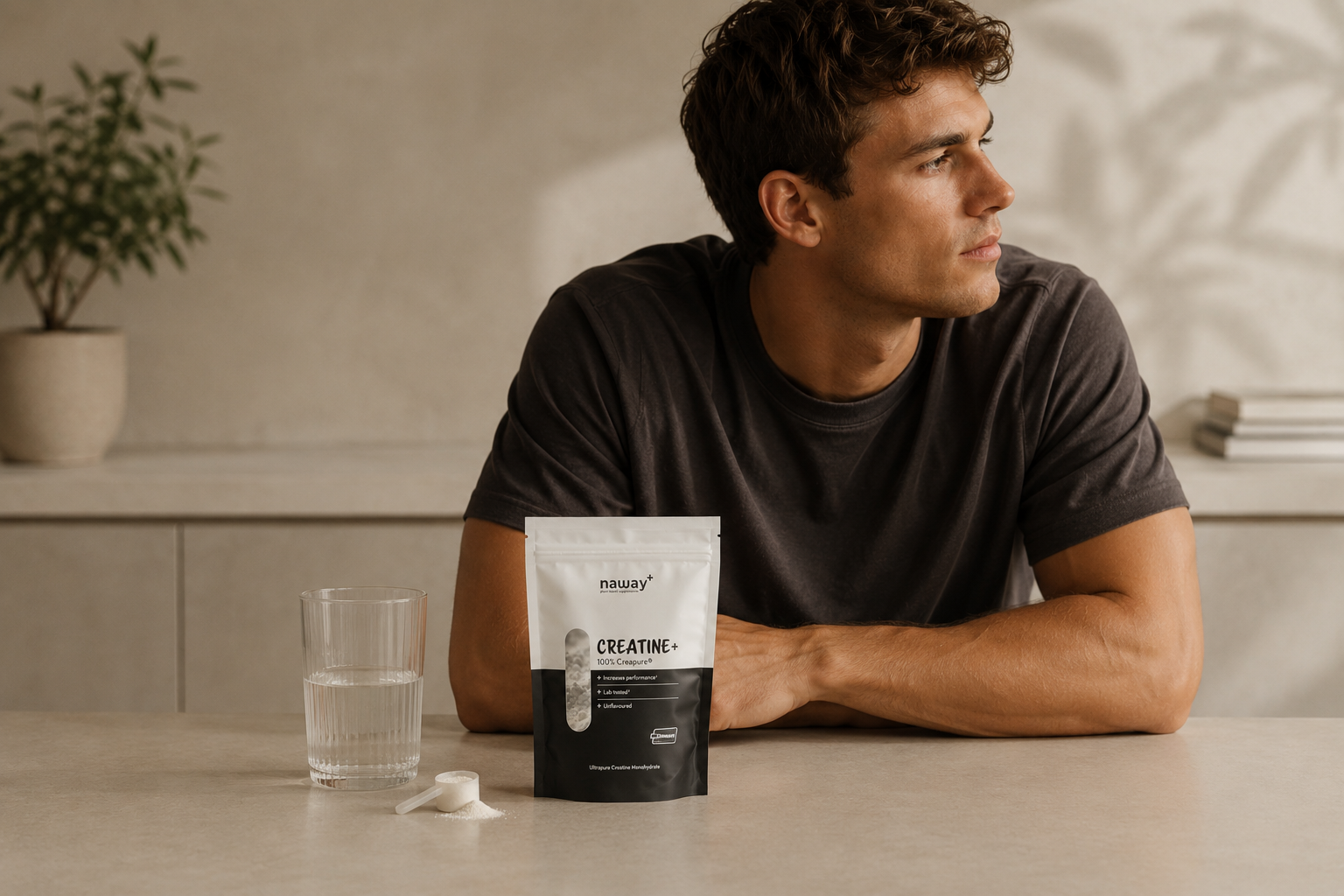
Our Creatine+ contains one ingredient: 100% Creapure® creatine monohydrate.
Creapure® is produced in Germany and allows us to use the form of creatine with the strongest overall body of scientific evidence while maintaining the sourcing and quality standards we want from a Naway product. Creatine+ contains no fillers or unnecessary extras.
Not because you need a fancy new form of creatine.
Quite the opposite.
Sometimes the ingredient with decades of research behind it is still the best choice.
References
- Hultman, E., et al. (1996). Muscle creatine loading in men. Journal of Applied Physiology. The research found a similar increase in muscle creatine after 3 g/day for 28 days compared with 20 g/day for six days, demonstrating that loading accelerates saturation but isn't required. Summarised in the 2021 JISSN evidence review. SpringerLink
- Antonio, J., et al. (2021). Common questions and misconceptions about creatine supplementation: what does the scientific evidence really show? Journal of the International Society of Sports Nutrition, 18, 13. SpringerLink
- Forbes, S.C., et al. (2021). Timing of Creatine Supplementation around Exercise: A Real Concern? Nutrients. Current evidence does not allow firm conclusions about an optimal pre- or post-exercise timing strategy. PubMed
- Green, A.L., et al. (1996). Carbohydrate ingestion augments skeletal muscle creatine accumulation during creatine supplementation in humans. American Journal of Physiology, 271, E821–E826. PubMed
- Steenge, G.R., et al. (2000). Protein- and carbohydrate-induced augmentation of whole body creatine retention in humans. Journal of Applied Physiology. PubMed
- Odoom, J.E., et al. (1996/1999). Research examining skeletal-muscle creatine transport showed that creatine uptake is strongly sodium dependent. PubMed
- Harris, R.C., et al. (2002). Absorption of creatine supplied as a drink, in meat or in solid form. Journal of Sports Sciences, 20(2), 147–151. PubMed
- Fazio, C., Elder, C.L. & Harris, M.M. (2022). Efficacy of Alternative Forms of Creatine Supplementation on Improving Performance and Body Composition in Healthy Subjects: A Systematic Review. Journal of Strength and Conditioning Research, 36(9), 2663–2670. PubMed
- Kreider, R.B., Jäger, R. & Purpura, M. (2022). Bioavailability, Efficacy, Safety, and Regulatory Status of Creatine and Related Compounds: A Critical Review. Nutrients, 14(5), 1035. PubMed

Share:
Do You Really Need Protein Right After Your Workout?