



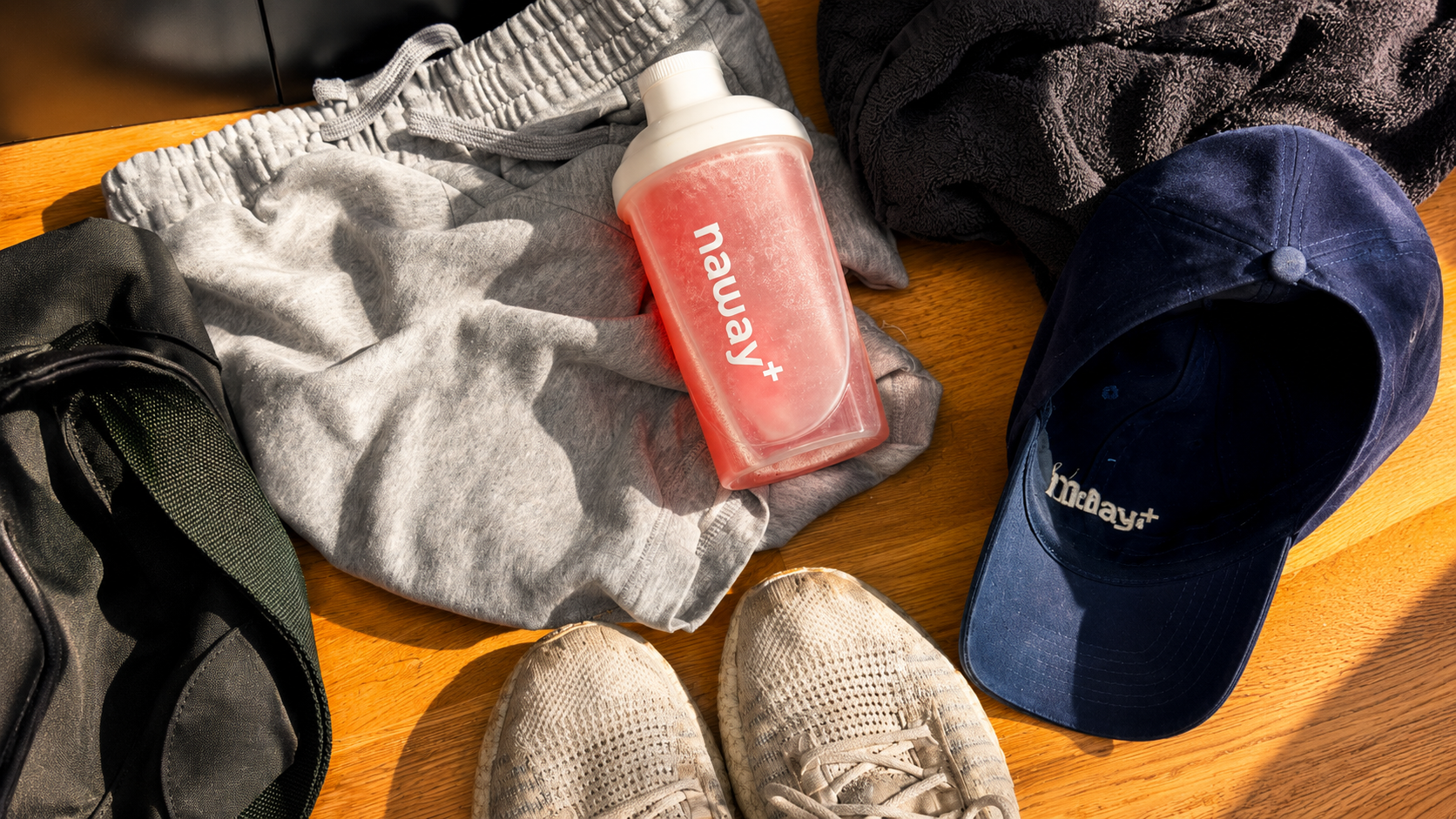
For years, the advice was simple:
Finish your workout. Drink your protein shake immediately.
Wait too long and you would supposedly “miss” the anabolic window and lose part of the muscle-building benefit from your training.
You still hear this today. People finish their last set and immediately reach for a shake because they believe the next 30–60 minutes are critical.
But is that actually what the science says?
Not quite.
The Myth of the Anabolic Window
The idea behind the anabolic window does make sense.
Resistance training stimulates muscle protein synthesis — the process your body uses to repair and build muscle tissue. Protein provides the amino acids needed for that process.
So naturally, researchers wanted to know whether consuming protein immediately after training could maximize the response.
This eventually turned into the idea of a very narrow “anabolic window”: consume protein within roughly 30–60 minutes after your workout, or you have missed your chance.
The problem?
The window is nowhere near that small.
Your Muscles Don't Stop Responding After 30 Minutes
Resistance training does not create a short burst of muscle-building activity that suddenly disappears an hour later.
Research has shown that your muscles remain more sensitive to amino acids for many hours after resistance exercise. One study even found that this increased sensitivity was still present 24 hours after training.[1]
That does not mean timing is completely irrelevant.
It means your body gives you a much bigger window than fitness culture once made us believe.
You do not need to finish your last set and race to your protein shaker.
What Matters More Than Timing?
This is where the research becomes much clearer.
Your total protein intake across the entire day matters more than whether you drink a shake 20 or 90 minutes after training.
A large meta-analysis examining protein timing found that once total protein intake was taken into account, consuming protein immediately around a workout did not significantly improve muscle growth or strength.[2]
Another major meta-analysis of 49 studies and 1,863 participants found that protein supplementation supported greater gains in muscle mass and strength during resistance training, with benefits appearing to level off around 1.6 g of protein per kilogram of body weight per day for muscle gain.[3]
For someone weighing 70 kg, that would be around:
70 × 1.6 = 112 g of protein per day.
That daily total is far more important than stressing about a 30-minute post-workout deadline.
But Protein After Your Workout Is Still a Good Idea
This is where the message can sometimes swing too far in the opposite direction.
The anabolic window may be exaggerated, but that does not mean there is no reason to eat protein after training.
Exercise primes your muscles to use amino acids for repair and growth. Giving your body protein during the hours around your workout is therefore still a sensible strategy.
A study in resistance-trained men compared consuming 25 g of protein immediately before training with consuming the same amount immediately after training.
After 10 weeks, there were no significant differences in muscle growth or strength between the groups.[4]
In other words, both worked.
What mattered was that protein was available around the training session — not which side of the workout it was consumed on.
When Timing Matters More
There is one important exception.
Imagine you ate a protein-rich meal at 12:00, trained at 17:00 and finished at 18:30.
At that point, getting some protein relatively soon after training makes sense because several hours have already passed since your last protein intake.
The same applies if you train first thing in the morning without eating beforehand.
On the other hand, if you had a meal containing plenty of protein an hour or two before your workout, there is much less reason to worry about immediately drinking a shake afterwards. Amino acids from that meal are still being digested and absorbed.
So the longer it has been since your last protein-rich meal, the more useful post-workout protein becomes.
How Much Protein Should You Have?
For most people, a good target is roughly 20–40 g of high-quality protein per meal, depending on body size, age and the rest of your diet.
Another useful guideline from the research is around 0.4 g of protein per kilogram of body weight per meal, spread across several meals during the day.[5]
For someone weighing 70 kg, that works out to roughly 28 g per meal.
You do not have to calculate every serving perfectly. The bigger goal is simply to spread meaningful amounts of protein throughout your day rather than eating very little protein all day and trying to make up for it with one enormous dinner.
So, Do You Need a Post-Workout Protein Shake?
Need one?
No.
A protein shake is not a magic muscle-building switch, and there is nothing special about drinking protein within exactly 30 minutes of your workout.
But it can still be incredibly practical.
After training, a shake gives you an easy way to get 20–30 g of protein without preparing another full meal. And if that helps you consistently reach your daily protein target, it absolutely has value.
That is really how protein supplements should be viewed:
not as a replacement for good nutrition and not as something you need to consume the second your workout ends — but as a convenient way to get enough high-quality protein throughout the day.
The Takeaway
The famous 30-minute anabolic window is largely a myth.
Your muscles stay responsive to protein for many hours after resistance training, and getting enough protein across the entire day matters much more than perfect post-workout timing.
So instead of watching the clock after your last set, focus on the bigger picture:
Get enough protein every day. Spread it across your meals. And try to get a good protein serving somewhere around your training session.
If a shake right after your workout makes that easier, great.
But if dinner is an hour or two away?
You haven't missed your gains.
References
-
Burd, N.A., et al. (2011). Enhanced amino acid sensitivity of myofibrillar protein synthesis persists for up to 24 h after resistance exercise in young men. The Journal of Nutrition, 141(4), 568–573. DOI: 10.3945/jn.110.135038.
-
Schoenfeld, B.J., Aragon, A.A. & Krieger, J.W. (2013). The effect of protein timing on muscle strength and hypertrophy: a meta-analysis. Journal of the International Society of Sports Nutrition, 10, 53. DOI: 10.1186/1550-2783-10-53.
-
Morton, R.W., et al. (2018). A systematic review, meta-analysis and meta-regression of the effect of protein supplementation on resistance training-induced gains in muscle mass and strength in healthy adults. British Journal of Sports Medicine, 52(6), 376–384. DOI: 10.1136/bjsports-2017-097608.
-
Schoenfeld, B.J., et al. (2017). Pre- versus post-exercise protein intake has similar effects on muscular adaptations.PeerJ, 5, e2825. DOI: 10.7717/peerj.2825.
-
Schoenfeld, B.J. & Aragon, A.A. (2018). How much protein can the body use in a single meal for muscle-building? Implications for daily protein distribution. Journal of the International Society of Sports Nutrition, 15, 10. DOI: 10.1186/s12970-018-0215-1.

Share:
Why Eating Less Protein Could Ruin Your Weight Loss Results
Creatine: 10 Common Questions Answered by Science